
Vibe Coding Agency Hiring Freelancers
Day 125 moved the Dollar Vibe Club Agency from an application concept toward an operating marketplace.
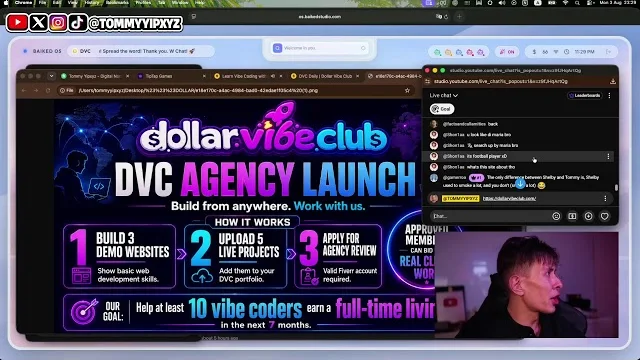
What we did
Day 125 moved the Dollar Vibe Club Agency from an application concept toward an operating marketplace. Tommy repaired the member application flow, made five portfolio projects and a valid Fiverr profile the practical entry gates, reviewed community work against an “Agency level” quality bar, and showed the accepted-member job board where approved builders will bid on routed client work. The first market is small and medium-sized business websites, with delivery and payments kept on Fiverr rather than handled by DVC. The stream stated ambitious seven-month income and scale goals, but it did not independently prove approved freelancers, completed orders, client acceptance, or revenue.
What we learned
- The Agency is designed as a proof-first work-routing layer: members show five strong projects, complete their profile, provide a valid Fiverr URL, pass review, and then gain access to bid on client work.
- DVC is intentionally not becoming the payment processor. Tommy repeatedly said contracts and monetary transactions should remain on Fiverr, using the platform as the commercial and reputation layer.
- The initial service wedge is focused: websites for small and medium-sized businesses. Complex applications belong elsewhere in the product roadmap, while Agency builders are expected to produce persuasive demo homepages that sell the client’s story quickly.
What we had planned
- Verify the entire authenticated Agency path with separate member and admin accounts: five-project gate, Fiverr URL validation, application submission, review, approval/rejection, accepted-member routing, and permission isolation.
- Turn “Agency level” into a written rubric covering live proof, visual quality, responsive behavior, client relevance, originality, security hygiene, and the exact reasons for approve, revise, or reject decisions.
- Define the Fiverr operating contract: who owns the client relationship, who sends custom offers, pricing and margin rules, delivery and revision responsibility, dispute handling, account-rating risk, and evidence of completion.